
- Apr 13, 2026
- 10 min read
How to Evaluate Your Electricity Costs Without Metering Equipment
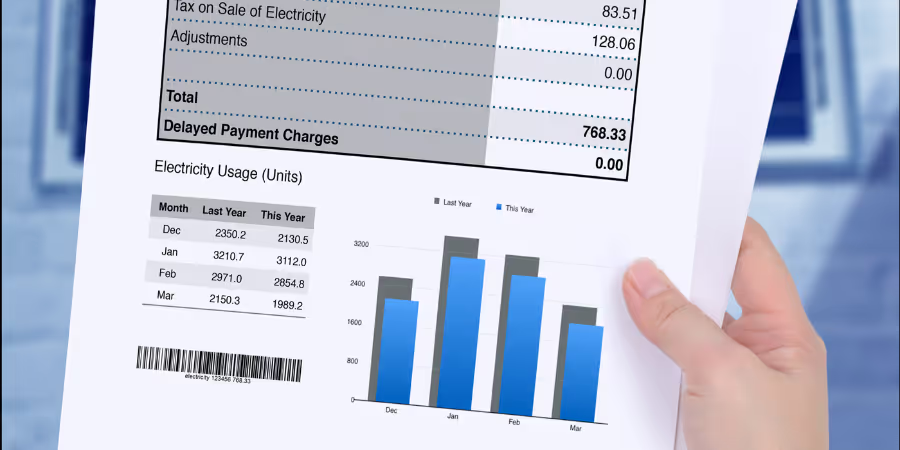
If your facility runs induction motors — compressors, HVAC, machine tools, conveyors, or presses — your utility bill almost certainly contains unnecessary penalties. Most plant managers either don’t know it’s there or don’t know how to find it. This guide gives you a self-service walkthrough on identifying power factor penalties: where to look on your bill, how to calculate your power factor with arithmetic alone, how to estimate what you’re paying, and how to decide whether corrective action makes financial sense. No metering equipment required.
Your Utility Bill Already Contains the Answer
Unlike residential bills, which show only kilowatt-hours consumed, commercial and industrial utility bills record how your facility draws power — not just how much. This distinction is what makes power factor penalties possible, and it’s also what makes them detectable without any specialized equipment.
A commercial meter records three separate demand values: kW (real power — what your equipment actually uses to do work), kVA (apparent power — the total current draw your utility must supply), and sometimes kVAR (reactive power — the portion that does no useful work but still flows through the utility’s infrastructure). Power factor is simply the ratio of kW to kVA. When that ratio falls below your utility’s threshold — typically 0.85 to 0.90 — you start paying for it.
The penalty may be labeled clearly, or it may be embedded in your demand charge. Either way, the data to find it is already on your bill.
Step 1: Find These Five Numbers on Your Bill
Pull your last three months of utility bills. You’re looking for up to five line items. Not all will appear on every bill — which items appear (and which don’t) is itself diagnostic information.
1. kW Demand (or Peak Demand): Your real power demand at peak — what your equipment actually needed to do work during the billing period’s highest 15- or 30-minute interval. This number appears on virtually every commercial bill.
2. kVA Demand (Apparent Power): If this number appears and is higher than your kW demand, your power factor is below 1.0. The gap between kW and kVA tells you the severity of the problem.
3. Power Factor: Some utilities state it directly as a decimal (e.g., 0.84) or percentage (84%). If you see it, note it — but verify it against your own calculation in Step 2.
4. kVAR or kVAR Demand: Reactive power, measured in kilovolt-amperes reactive. If this line item appears on your bill, your utility is actively measuring and may be billing reactive power.
5. Power Factor Adjustment, Reactive Demand Charge, or Power Factor Penalty: This may appear as “Reactive energy charge,” “Power factor penalty,” “Demand adjustment,” or a separate kVAR demand line. This is the penalty itself.
If your bill shows items 1 and 2, proceed to Step 2. If your bill shows only kW demand and no kVA, proceed to Step 3 — your penalty may be embedded rather than explicit.
Step 2: Calculate Your Power Factor
If your bill shows both kW demand and kVA demand, calculating your power factor requires no equipment — just division:
Power Factor = kW Demand ÷ kVA Demand
Two field examples illustrate the range:
- A bill showing kW demand of 231.36 and kVA demand of 249.60 gives a power factor of 0.927 — above the typical penalty threshold of 0.90, no penalty triggered.
- A bill showing kW demand of 2,155 and kVA demand of 3,060 gives a power factor of 0.70 — well below threshold, and almost certainly generating a significant monthly penalty.
If your calculated power factor is above 0.95, you’re in good shape. Between 0.90 and 0.95, you’re likely at or near your utility’s threshold — worth monitoring. Below 0.90 means you are almost certainly paying a penalty. Below 0.85 means the penalty is likely substantial.
Calculate this for each of your three months of bills. If the number is consistently below threshold, this isn’t a one-time anomaly — it’s a recurring monthly cost.
Step 3: Find the Hidden Penalty Structure on Your Bill
Utilities structure power factor penalties in three different ways. Knowing which structure your utility uses determines how visible the penalty is on paper.
Structure 1 — kVA Billing: Your demand charge is billed in kVA rather than kW. There may be no separate “penalty” line at all — the penalty is automatic. Every drop in power factor inflates your kVA demand number and your bill along with it. If your demand charge line reads in kVA (not kW), this is your structure.
Structure 2 — Demand Adjustment (Multiplier): Your bill shows kW demand, but the utility applies a multiplier when your power factor falls below threshold. The formula is:
Billed Demand = Actual kW × (Threshold PF ÷ Actual PF)
For example, a facility with actual demand of 500 kW at a 0.80 power factor, where the utility’s threshold is 0.90, would be billed for 500 × (0.90 ÷ 0.80) = 562.5 kW — 62.5 extra units of demand every month. At $15/kW, that’s $937.50/month in added cost. The tell-tale sign on the bill: your billed kW is higher than your metered kW, or there’s an explicit “Demand Adjustment” multiplier line.
Structure 3 — Direct kVAR Charge: A separate line item charges reactive power in kVAR at a per-unit rate (e.g., $0.15/kVAR). This is the most transparent structure — the penalty is explicit and line-itemed. If you see “kVAR Demand Charge” or “Reactive Energy Charge” on your bill, this is your structure.
If your bill shows only kW demand with no kVA, kVAR, or adjustment lines, and your demand charge seems high relative to your kWh consumption, you may be on Structure 2 with the adjustment embedded. Contact your utility’s commercial accounts team and ask specifically which demand billing structure applies to your rate schedule.
Step 4: Estimate What You’re Actually Paying in Penalties
Once you’ve identified your billing structure and calculated your power factor, you can estimate your monthly penalty cost directly.
For kVA billing or demand adjustment structures:
Find your utility’s demand charge rate ($/kW or $/kVA — listed in your rate schedule or on the bill itself). Then:
Monthly Penalty ≈ (Billed Demand − Actual kW Demand) × Demand Rate
Or, using the adjustment formula:
Monthly Penalty = Actual kW × [(Threshold PF ÷ Actual PF) − 1] × Demand Rate
A worked example: A manufacturing facility with 850 kW peak demand, a measured power factor of 0.82, a utility threshold of 0.90, and a demand rate of $14/kW:
- Billed demand = 850 × (0.90 ÷ 0.82) = 932.9 kW
- Excess billed demand = 932.9 − 850 = 82.9 kW
- Monthly penalty = 82.9 × $14 = $1,160/month
- Annual penalty = $13,920
That’s a real number that disappears entirely with a properly sized correction system. A 2023 industry study found that 63% of U.S. industrial operators faced power factor penalties averaging $7,200 per year — and most weren’t aware the charges existed as a separate cost category.
For the direct kVAR charge structure: multiply your billed kVAR demand by the per-unit rate shown on your bill. That figure is your monthly reactive power cost, stated explicitly.
What Your Bill Can’t Tell You — And Where Metering Fills the Gap
Your bill analysis tells you whether you’re being penalized and approximately how much. It cannot tell you when during the day your power factor drops, which production shift or equipment is causing the worst readings, or how rapidly your power factor fluctuates.
This matters because it affects the design of any correction system. A facility with a stable, consistent low power factor can be corrected cost-effectively with fixed capacitor banks. A facility whose power factor swings rapidly — driven by variable-speed drives, large motor startups, or cyclical loads — requires a continuously variable correction system that can respond in real time.
Your utility bill shows a monthly billing average. That average hides the story beneath it. A metered reading at your main electrical panel gives you power factor at every 15-minute interval — revealing whether your problem is worst on first shift, whether it spikes when the compressors cycle, and whether your power factor moves fast enough to require a dynamic response. Power quality monitoring also captures harmonic content, which can affect correction system design if present at significant levels.
For a plant manager doing initial self-qualification, the bill analysis is the right first step. If your bill confirms a penalty, the logical next step is a professional site assessment — not purchasing your own metering equipment. A proper assessment meters the right measurement points (service entrance, individual feeder panels, specific large loads), evaluates harmonic content, and produces a load profile that determines whether variable or fixed correction is more appropriate for your facility.
How to Decide Whether You Need to Act
After your bill review, your facility falls into one of three categories:
No action needed now (Green):
- Your calculated power factor (kW ÷ kVA) is above 0.95
- Your bill shows no kVAR, kVA demand, or Power Factor Adjustment line items
- Your kW demand and kVA demand are equal or within 2–3%
Worth investigating further (Yellow):
- Your bill shows kVA demand higher than kW demand, but no explicit penalty line
- Your calculated power factor is between 0.88 and 0.95
- Your kW demand seems high relative to your kWh consumption, but you can’t identify why
- You can’t locate or interpret the relevant line items on your bill
You are likely paying a penalty right now (Red):
- Your bill explicitly shows “Power Factor Adjustment,” “Reactive Demand Charge,” or “kVAR Penalty”
- Your calculated power factor (kW ÷ kVA) is below 0.90
- Your billed kW demand is higher than your metered kW demand after a demand adjustment multiplier
- Your estimated annual penalty is above $3,000
If you’re in the yellow or red category, the next step is a free bill review with an engineer who can confirm the penalty amount, identify the likely cause, and tell you whether correction is cost-justified at your facility’s demand level.
Frequently Asked Questions
My bill only shows kWh and kW demand — does that mean I’m not being charged for power factor?
Not necessarily. Some utilities embed the power factor penalty in the demand charge rather than listing it separately. If your demand charge seems disproportionately high relative to your energy consumption, or if you notice a “Demand Adjustment” multiplier on your bill, you may be on a rate schedule that applies the penalty silently. Contact your utility’s commercial accounts team and ask which rate schedule you’re on and whether it includes a power factor adjustment provision.
My power factor is listed as 0.88 on my bill. Am I paying a penalty?
It depends on your utility’s threshold. Duke Energy’s North Carolina industrial rate schedules apply a power factor adjustment when power factor falls below 0.85, while other utilities set the threshold at 0.90. At 0.88, you may be below threshold with some utilities and just above with others. Check your rate schedule (listed on your bill or available on your utility’s website) for the specific threshold language.
What’s the difference between a kVAR charge and a power factor adjustment — are they the same thing?
They achieve the same outcome — billing you for reactive power — through different mechanisms. A kVAR charge is explicit: a per-unit fee on measured reactive power demand, appearing as a line item. A power factor adjustment is a multiplier applied to your real power demand, inflating your billed kW when your power factor falls below threshold. Both penalize the same underlying problem; the kVAR charge structure is more transparent because the cost is stated directly.
I called my utility and they said my power factor is fine. Should I still investigate?
Utilities use monthly billing averages to determine penalty status. A utility representative saying “your power factor is fine” typically means your monthly average met the billing threshold — not that your power factor is consistently good throughout the month. If your facility has large, intermittent loads (compressors cycling, large motor startups, batch production), your power factor may dip significantly during production hours while averaging out over the full month. A 30-day metered reading tells the real story.
How often does my utility measure my power factor — is it every month or constantly?
Most utilities calculate a monthly average power factor for billing purposes, derived from the ratio of total kWh to total kVAh (or from demand interval readings) over the billing period. A few utilities bill on interval-by-interval demand readings, which can result in higher effective penalties if your worst power factor readings occur during your peak demand interval. Your rate schedule will specify the measurement methodology.
If I install power factor correction, how quickly will I see the penalty disappear from my bill?
Most utilities remove power factor penalties within one to two billing cycles after your measured power factor consistently meets their threshold. A properly sized variable capacitance correction system brings power factor to 0.95–0.98 essentially immediately upon installation. We recommend notifying your utility account representative after installation and requesting a billing review for the first corrected billing period to confirm the adjustment has been applied.