- Apr 11, 2026
- 5 min read
What Is Power Factor and Why Do Utilities Charge a Penalty for It?
Power factor is a measurement of how efficiently your facility converts electricity into productive work. If your plant operates with a power factor below your utility's threshold—typically 0.85 to 0.95—you are paying a monthly penalty for power you draw but never use. For a mid-sized manufacturing facility running 24/7, that penalty commonly ranges from $1,400 to $2,500 per month, and most plant managers don't realize they're paying it.
Power factor (PF) is the ratio of real power—the electricity that performs work, measured in kilowatts (kW)—to apparent power, the total electricity your utility must supply, measured in kilovolt-amperes (kVA).
Power Factor = Real Power (kW) ÷ Apparent Power (kVA).
A rating of 1.0 is perfect efficiency; a rating of 0.80 means 20% of the current supplied to your facility generates no productive output whatsoever. The best analogy is a glass of beer: the liquid is real power doing actual work, and the foam is reactive power—present, taking up capacity, but contributing nothing useful.
The root cause in almost every manufacturing facility is inductive loads—electric motors, transformers, and welding equipment. These machines require reactive power to maintain their magnetic fields, drawing current from the grid that produces no real work and pulling your power factor down.

The penalty is not arbitrary. When your facility has a low power factor, your utility must generate and transmit significantly more current to deliver the same useful power. At 0.70 PF, a utility supplies 1.4 times the current it would need at 1.0—and because line losses increase with the square of current, those losses effectively double. That infrastructure cost gets passed back to you. Most utilities across the East Coast use one of three billing structures: kVA Billing, a Demand Adjustment multiplier, or a direct kVAR Charge per unit of reactive power consumed above a permitted threshold.
The highest-risk facilities share one characteristic: large induction motors that cycle on and off, or run at partial load for extended periods. Sawmills, metal fabrication shops, and food processing plants—with their debarkers, press brakes, conveyors, and refrigeration compressors—consistently produce facility-wide power factors in the 0.72–0.85 range without correction. Welding equipment, induction furnaces, and stamping machines compound the problem further, drawing heavy reactive current in short bursts that traditional switched capacitor systems struggle to track.
The financial case for power factor correction is straightforward. Facilities correcting power factor from the 0.72–0.85 range up to 0.95 consistently achieve payback periods of 12 to 24 months. For a facility paying $1,500/month in reactive power penalties, a correction system that eliminates that charge pays for itself within two years—and then generates $18,000 per year in pure savings for the life of the equipment, typically 15 to 20 years.
Beyond penalty elimination, correcting power factor reduces current draw throughout your entire electrical system. Lower current means cooler conductors, cooler motors, and less thermal stress on transformers and switchgear. Studies published by IEEE found that power factor correction can reduce motor operating temperatures by up to 20%—extending motor lifespan significantly and reducing maintenance intervals. It also frees capacity on your existing transformers and service entrance, allowing you to add equipment or expand production without a costly electrical service upgrade.
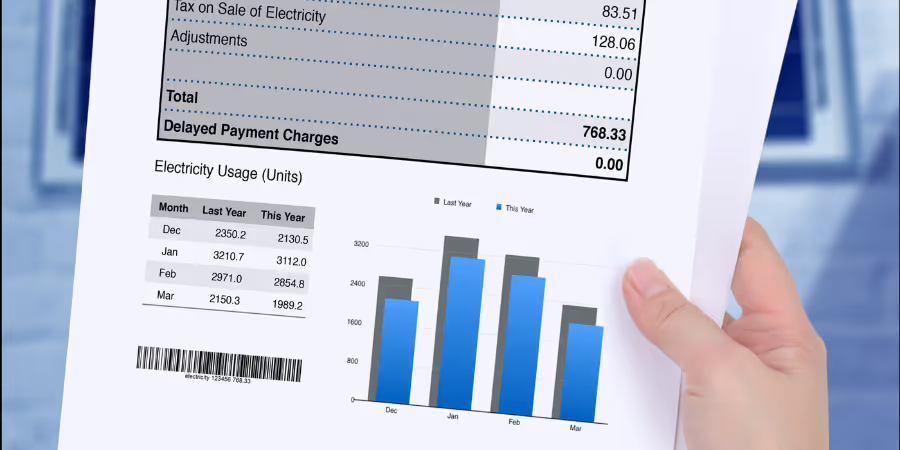
Power factor is not an abstract electrical concept—it is a direct line item on your utility bill, and for most manufacturing facilities operating motor-heavy equipment, it represents thousands of dollars per month in avoidable cost. If you operate a manufacturing facility in North Carolina or across the East Coast and aren't certain what your current power factor is, pull your last three utility bills and look for kVA-based demand charges or power factor adjustment line items.